


Residential vs Commercial Real Estate in Dubai: Which Is Better?
Residential vs Commercial Real Estate in Dubai: Which Is the Better Investment?
Dubai’s real estate market offers investors a wide range of opportunities, from apartments and villas to offices, retail spaces and industrial properties. But with so many options available, one important question often comes up: should you invest in residential or commercial real estate in Dubai?
Both property types can generate rental income and long-term capital growth, but they work differently. Residential properties generally benefit from demand from individuals and families, while commercial properties are closely linked to business activity, corporate expansion and economic growth.
Dubai’s market continues to attract strong investment. According to the Dubai Land Department, real estate transactions reached AED 252 billion in Q1 2026, up 31% year-on-year, while real estate investment value reached AED 173 billion.
So, which option makes more sense for an investor?
The answer depends on your budget, investment objectives, risk tolerance, expected returns and investment horizon.
Let’s look at the key differences between residential and commercial real estate in Dubai.
Residential vs Commercial Real Estate: What’s the Difference?
The simplest distinction is based on how the property is used.
Residential real estate is designed primarily for people to live in. This includes:
- Apartments
- Villas
- Townhouses
- Serviced residences
- Other housing units
Commercial real estate, on the other hand, is used for business and commercial activities. It can include:
- Office spaces
- Retail units
- Shops
- Warehouses
- Industrial properties
- Business premises
The difference goes beyond property type. Residential and commercial investments also differ in terms of tenants, lease structures, purchase costs, management requirements, liquidity and potential returns.
Residential Real Estate in Dubai
Residential property remains one of the most accessible ways to participate in Dubai’s real estate market.
The city attracts residents from around the world, creating continuous demand for housing across different price segments. Dubai Land Department data also shows the strength of the rental market: registered tenancy contracts increased 6% in volume and 17% in value during 2025, reaching 1.38 million contracts worth AED 126.4 billion.
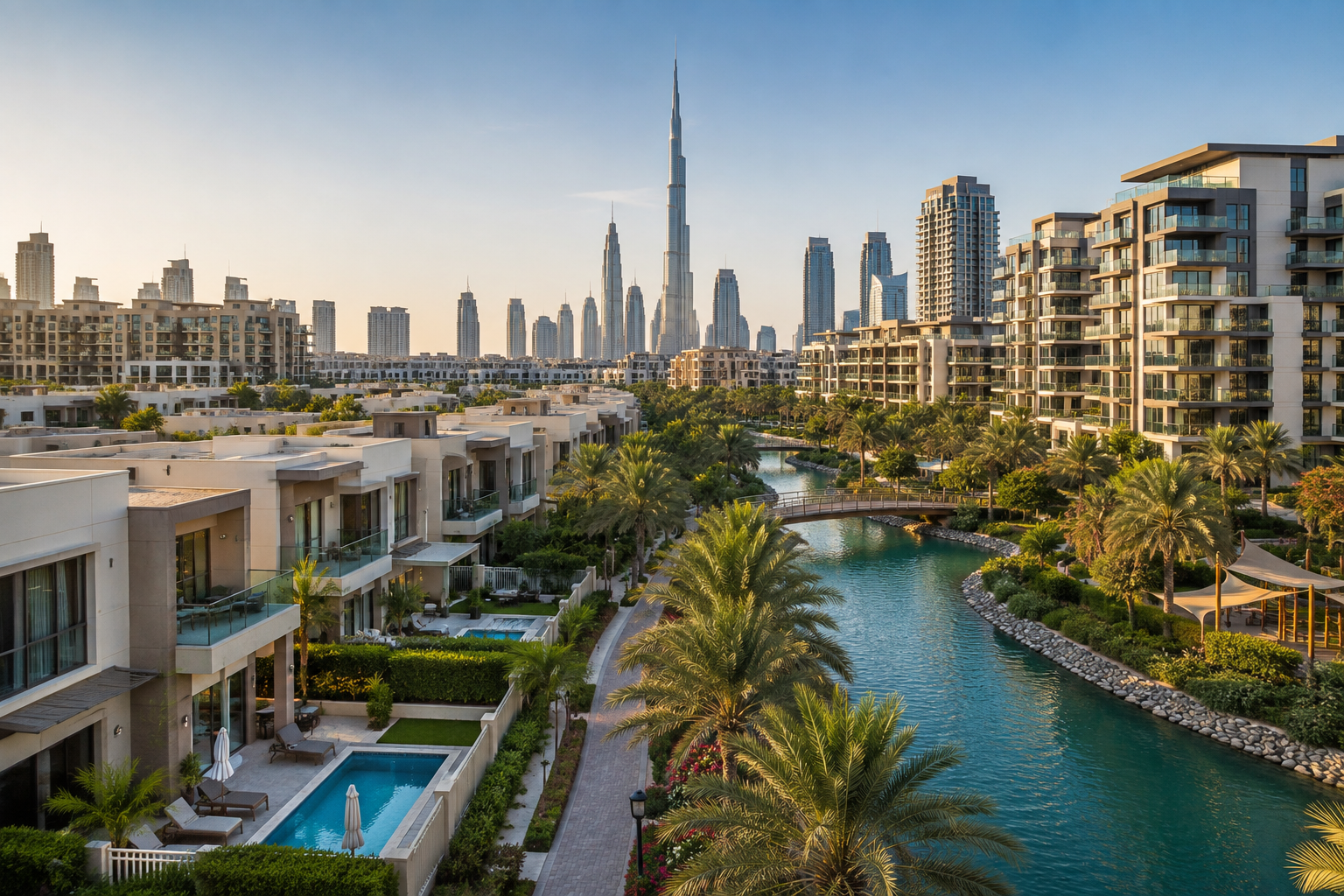
Why Do Investors Choose Residential Property?
Residential real estate can appeal particularly to investors looking for:
- A broad pool of potential tenants
- Relatively straightforward property management
- Regular rental income
- More accessible investment options
- Potential capital appreciation
- Easier resale compared with some specialised commercial assets
Areas such as Downtown Dubai, Dubai Marina, Jumeirah Village Circle, Dubai Hills Estate and other established communities attract different categories of residents and investors.
However, location matters enormously. A residential property in an area with strong rental demand can perform very differently from a similar property in an oversupplied or less connected location.
Commercial Real Estate in Dubai
Commercial real estate offers a different investment proposition.
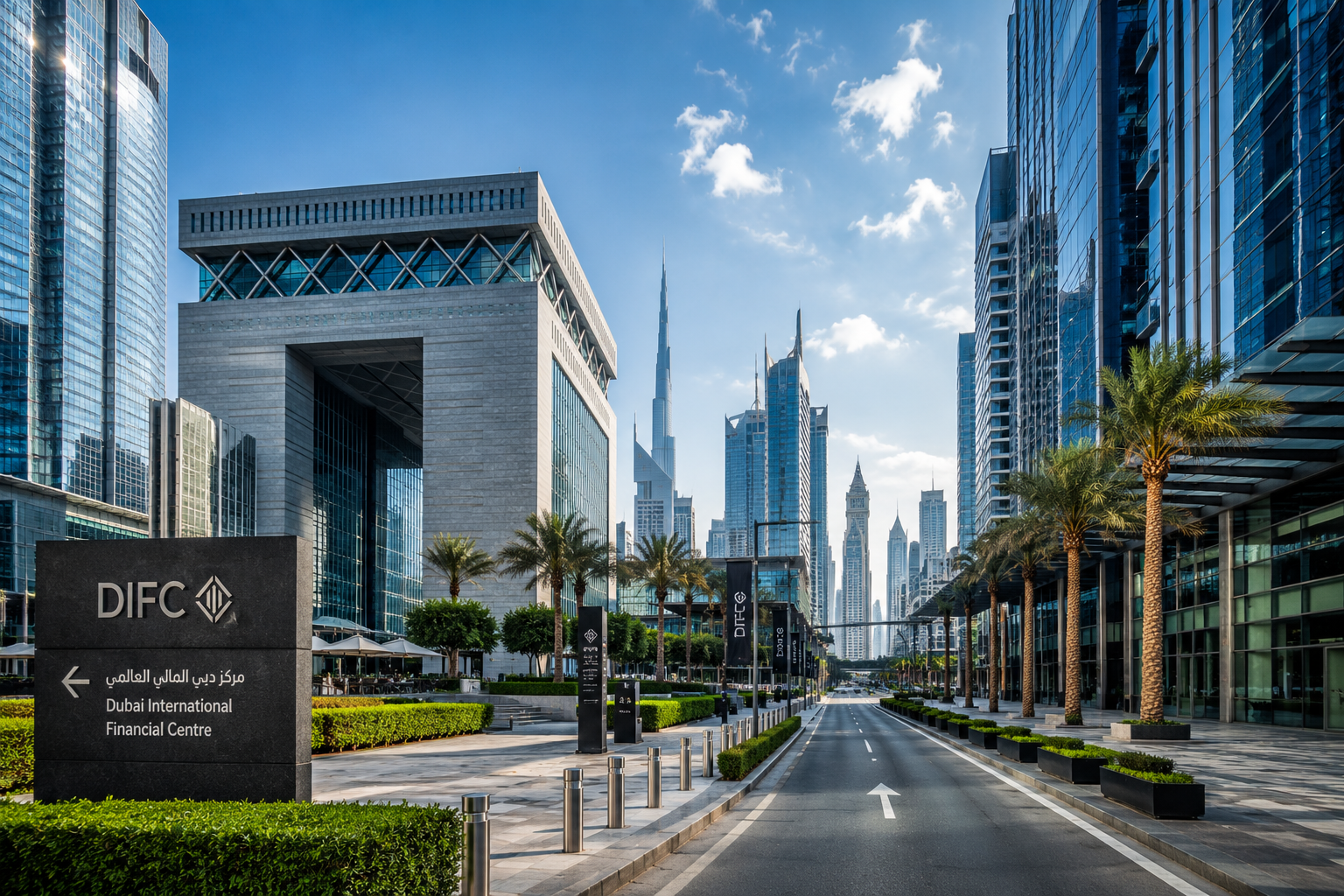
Dubai’s position as an international business and trading hub creates demand for offices, retail units, warehouses and other commercial spaces.
The commercial sector is also influenced by factors such as:
- Business formation
- Corporate expansion
- Tourism
- Trade
- Logistics
- Employment growth
- Economic activity
Recent market data highlights the strength of Dubai’s office sector. CBRE reported that Dubai office rents increased 13% year-on-year in Q2 2026, while occupancy was around 94%.
This illustrates why commercial property can be attractive to investors seeking stronger income potential—but it also comes with its own risks.
Residential vs Commercial Real Estate in Dubai: Key Differences
Before choosing an investment, it helps to compare both asset classes directly.
| Factor | Residential Real Estate | Commercial Real Estate |
|---|---|---|
| Main tenants | Individuals & families | Businesses & companies |
| Property types | Apartments, villas, townhouses | Offices, retail, warehouses |
| Entry cost | Often more accessible | Generally higher |
| Lease structure | Usually shorter | Often longer |
| Tenant pool | Broad | More specialised |
| Management | Generally simpler | Can be more complex |
| Liquidity | Usually higher | Can be lower |
| Rental income | Generally stable | Potentially higher |
| Vacancy impact | Often easier to manage | Vacancy can be costly |
| Market drivers | Population & housing demand | Business & economic activity |
| Investment profile | Accessible & diversified | Higher potential, higher complexity |
There is no universal winner. The better investment depends on what you are trying to achieve.
1. Investment Cost
One of the biggest differences between residential and commercial real estate is the amount of capital required.
Residential properties are available across a wide range of price points, allowing investors to choose between different apartment, villa and townhouse options.
Commercial properties can require significantly more capital, particularly for larger offices, retail units, warehouses and industrial assets.
This means residential real estate can be more accessible for first-time investors, while commercial property may suit investors with greater capital and a higher tolerance for complexity.
However, purchase price should never be the only consideration.
A cheaper property with weak rental demand may produce a worse investment outcome than a more expensive property in a strong location.
2. Rental Yield and Income Potential
Rental yield is one of the most important factors investors consider.
Residential properties can provide attractive rental income, particularly in locations with strong tenant demand. Their large potential tenant pool can also help reduce the risk of prolonged vacancy.
Commercial properties, meanwhile, can offer stronger income potential depending on the property type, location, tenant and lease structure.
For example, Dubai’s office market has recently experienced strong rental growth amid limited supply and resilient occupier demand.
But a higher potential yield should not automatically be interpreted as a better investment.
Investors should consider:
Rental income − operating costs − service charges − maintenance − vacancy = actual investment performance
Looking only at the headline rental yield can give an incomplete picture.
3. Lease Terms and Tenant Stability
Residential tenants commonly sign shorter leases, which can give landlords greater flexibility but may also mean more frequent tenant turnover.
Commercial leases are often longer, particularly when businesses invest heavily in fitting out their premises.
A long-term commercial tenant can therefore provide greater income visibility.
However, there is another side to this.
If a commercial tenant leaves, finding a replacement can take longer because the property may be suitable for a much smaller pool of businesses.
That makes tenant quality and property location especially important in commercial real estate.
4. Liquidity and Resale Potential
Liquidity refers to how easily an asset can be sold without significantly affecting its value.
Residential properties generally have a broader pool of potential buyers because they can appeal to:
- End users
- Families
- First-time investors
- International buyers
- Landlords
- Long-term investors
Commercial properties can have a narrower buyer pool because buyers often evaluate the asset based on business performance, lease income, tenant quality and expected returns.
This does not mean commercial property is difficult to sell.
It simply means the resale decision can involve more specialised considerations.
5. Management and Maintenance
Residential property management is generally more familiar and straightforward.
The owner may deal with:
- Tenant communication
- Maintenance requests
- Service charges
- Renewals
- Property inspections
Commercial property can involve more complicated requirements depending on the asset.
Office, retail and industrial tenants may have specific operational requirements, fit-out needs and contractual responsibilities.
Some commercial lease structures may also place certain operating or maintenance responsibilities on tenants.
Therefore, investors should carefully review the lease agreement rather than assuming all commercial properties have the same cost structure.
6. Vacancy Risk
Vacancy is an important consideration for both residential and commercial investors.
With residential property, a broad tenant pool can make it easier to find a replacement tenant in areas with strong demand.
Commercial vacancy can have a larger financial impact because commercial properties often have higher operating costs and larger spaces.
A vacant retail unit, office or warehouse can potentially remain unoccupied for a longer period while the owner searches for an appropriate tenant.
This is why location, tenant demand and property suitability matter so much when buying commercial real estate.
Advantages of Residential Property Investment in Dubai
Residential real estate can offer several advantages.
1. Broad Tenant Demand
Dubai’s growing population and international workforce support demand for different types of residential accommodation.
2. More Accessible Entry Points
Investors can choose from properties across a wide range of locations, sizes and price points.
3. Easier Diversification
An investor may be able to spread capital across different residential properties or locations rather than committing to one large commercial asset.
4. Strong Resale Market
Residential properties can appeal to both investors and end users, creating a broader potential buyer pool.
5. Simpler Investment Structure
For many investors, residential property is easier to understand and manage compared with specialised commercial assets.
Challenges of Residential Real Estate Investment
Residential investment isn’t risk-free.
Investors should consider:
- Service and maintenance charges
- Property management costs
- Market fluctuations
- Competition from new developments
- Vacancy periods
- Tenant turnover
- Off-plan completion risks
- Changing rental demand
Dubai Land Department provides tools such as the Rental Index, Service Charge Index, property valuation and real estate transaction data, which can help investors conduct more informed research before making decisions.
Advantages of Commercial Property Investment in Dubai
Commercial real estate can be particularly attractive to investors focused on income and long-term leases.
1. Potentially Higher Rental Returns
Depending on the asset, location and tenant, commercial properties can generate strong rental income.
2. Longer Lease Structures
Businesses often prefer longer-term arrangements, which can provide greater income visibility.
3. Professional Tenants
Commercial properties may attract established companies, retailers, logistics businesses or other professional tenants.
4. Strong Business Demand
Dubai’s role as a global business hub supports demand for offices, retail and logistics facilities.
5. Potential for Rental Growth
Where supply is constrained and occupier demand remains strong, commercial rents can increase.
Risks of Commercial Real Estate Investment
The potential for higher returns comes with additional considerations.
Commercial investors may face:
- Higher initial capital requirements
- Longer vacancy periods
- More specialised properties
- Greater sensitivity to economic cycles
- Higher tenant concentration risk
- More complex lease agreements
- A smaller pool of potential buyers
For this reason, commercial property requires careful due diligence.
Investors should assess the tenant, lease duration, rental income, location, operating costs, property condition and future demand before purchasing.
Residential vs Commercial Real Estate: Which Is Better?
There isn’t one answer that works for every investor.
Residential may be more suitable if you:
- Are investing for the first time
- Have a smaller investment budget
- Want a broader tenant pool
- Prefer simpler management
- Prioritise liquidity
- Want to diversify across multiple properties
Commercial may be more suitable if you:
- Have greater investment capital
- Want potentially higher rental income
- Prefer longer lease structures
- Understand commercial market dynamics
- Can tolerate longer vacancy periods
- Are comfortable with more complex property management
The right choice should be based on your investment strategy rather than simply choosing whichever property has the highest advertised yield.
How to Choose Between Residential and Commercial Property in Dubai
Before making a decision, ask yourself five questions:
1. What is my investment budget?
Calculate not only the purchase price but also transaction costs, financing, service charges, maintenance and potential vacancy.
2. What type of return am I targeting?
Are you primarily interested in rental income, capital appreciation, or a combination of both?
3. How much risk can I accept?
Commercial properties may offer higher income potential but can also expose investors to greater vacancy and tenant risks.
4. How involved do I want to be?
If you prefer a relatively straightforward investment, residential property may be more suitable. Commercial property can require more detailed analysis and active oversight.
5. What is my investment timeline?
An investor planning to hold a property for many years may evaluate an asset differently from someone who wants to sell within a few years.
Location Matters More Than Property Type
One of the biggest mistakes investors make is asking:
“Is residential or commercial better?”
before asking:
“Where and why am I investing?”
A well-located residential property can outperform a poorly positioned commercial property.
Similarly, a strategically located commercial property with strong tenant demand can outperform a residential unit in an oversupplied area.
Investors should therefore analyse:
- Connectivity
- Nearby infrastructure
- Population growth
- Business activity
- Rental demand
- Existing and upcoming supply
- Developer reputation
- Property quality
- Tenant profile
- Future development plans
Dubai Land Department’s real estate data platform allows investors and market participants to explore transaction, rental, project, valuation, land, building, unit and developer data.
The Bottom Line: Residential or Commercial Real Estate?
Residential and commercial real estate both have a strong role in Dubai’s investment market, but they serve different investment strategies.
Residential property can offer accessibility, broad tenant demand and relatively straightforward management. Commercial real estate can provide longer leases and stronger income potential, but it usually requires more capital, deeper market knowledge and greater tolerance for vacancy and tenant-related risks.
Dubai’s continuing real estate activity makes the decision particularly relevant. With AED 252 billion in transactions recorded during Q1 2026 and strong rental activity continuing through 2025, the market presents opportunities across both residential and commercial segments.
Ultimately, the best investment isn’t simply the property offering the highest advertised return.
It is the property that matches your capital, risk profile, investment horizon and long-term objectives.
For investors considering residential or commercial real estate in Dubai, thorough market research and professional guidance can help identify opportunities with stronger fundamentals and long-term potential.