
- By USquare Luxe Properties
- September 26, 2026
Nature-Led Design in the UAE: The Future of Sustainable Real Estate
The UAE’s real estate landscape is changing. For many years, residential development was largely associated with location, architecture, amenities and connectivity. Today, the way a community interacts with its surrounding environment is becoming an increasingly important part of urban planning and residential design.
This shift can be seen in the growing focus on parks, open spaces, walkable neighbourhoods, green corridors, outdoor recreation and environmentally responsible infrastructure. In Dubai, the Dubai 2040 Urban Master Plan identifies healthy communities, parks and open spaces, people-centred accessibility, environmental quality and resilience as important planning objectives.
The idea behind nature-led communities goes beyond adding trees and landscaped gardens. It involves considering nature, outdoor movement, public spaces, climate conditions and community facilities as connected elements of the overall master plan.
As the UAE continues to expand its residential and mixed-use developments, this approach could play an increasingly important role in how future communities are designed.
What Are Nature-Led Communities?
A nature-led community is a residential or mixed-use development where natural elements and outdoor spaces are considered as part of the community’s planning and design rather than being treated as an afterthought.
These elements can include:
- Parks and landscaped areas
- Green corridors
- Walking and cycling routes
- Shaded pedestrian pathways
- Community gardens
- Outdoor recreation areas
- Water features
- Natural or adapted landscaping
- Tree-lined streets
- Public gathering spaces
- Environmentally responsive infrastructure
The important difference is integration.
In a conventional development, buildings, roads and infrastructure may form the primary structure, with landscaping added around them. In a nature-led approach, landscape, movement, public spaces and buildings can be planned together.
Dubai’s latest urban planning framework specifically includes policies to protect natural conservation areas, develop ecological corridors, provide a high-quality parks and recreation system, preserve waterfronts and waterways, and promote sustainable mobility.
This shows that nature and outdoor space are increasingly being considered as part of wider urban planning rather than simply as decorative features.
Why Are Nature-Led Communities Growing in the UAE?
Several factors are contributing to this shift.
1. Rapid Urban Development
The UAE continues to develop new residential districts, commercial areas and mixed-use communities.
As cities become denser and new neighbourhoods are planned, developers and planners need to consider not only how many buildings can fit into an area, but also how residents will move, interact and use outdoor spaces.
Dubai 2040 aims to coordinate future urban development while improving environmental quality, accessibility, parks and open spaces.
This creates a broader planning environment in which green infrastructure and public spaces become part of the conversation around future development.
2. Changing Expectations of Homebuyers
Modern property buyers do not necessarily look only at the size or interior specification of a home.
Community-level features can also influence how a property is experienced.
Buyers may consider:
- Walking routes
- Children’s outdoor areas
- Parks
- Fitness facilities
- Landscaping
- Community spaces
- Accessibility
- Privacy
- Nearby retail and services
This is particularly relevant for family-oriented residential developments, where residents may spend significant time outside their individual homes.
Dubai’s real estate market has also seen continued activity in residential development. According to Dubai Land Department, 2025 recorded growth in completed projects, projects under construction and residential unit sales.
As the supply of residential communities expands, differentiation can increasingly come from how the entire community is planned, rather than from the building alone.
How Nature Is Being Integrated Into Community Planning
Nature-led development is not simply about increasing the number of plants.
There are several layers to the concept.
Green Corridors
Green corridors can connect parks, residential areas and community facilities.
Instead of isolated landscaped spaces, connected green areas can create routes for walking, cycling and outdoor recreation.
Dubai’s 2040 framework includes the development of ecological corridors alongside policies for parks, recreation and active mobility.
Parks and Open Spaces
Parks can serve multiple purposes within a residential community.
They can provide space for:
- Walking
- Exercise
- Children’s activities
- Informal gatherings
- Relaxation
- Community events
Dubai Municipality’s Greenery and Plantation Manual 2026 provides guidance for the planning, design, delivery and long-term maintenance of parks, green corridors, recreational spaces and landscaped rights of way. The manual also highlights biodiversity, sustainable irrigation, connectivity, walking and cycling, and reducing the urban heat-island effect.
Walkable Community Design
Another important element is the relationship between homes and everyday destinations.
If residents can comfortably walk to a park, community facility, retail area or recreational space, outdoor areas become part of daily life rather than something people visit occasionally.
Dubai has also introduced planning initiatives focused on pedestrian-friendly areas and sustainable mobility. The Dubai 2040 framework promotes active mobility-friendly streets and integrated land use and transport.
Nature-Led Design and the UAE Climate
One of the biggest differences between nature-led development in the UAE and similar concepts in cooler climates is the importance of climate-responsive design.
Outdoor spaces have to work within hot and dry conditions.
This means that successful landscaping requires more than simply planting large quantities of greenery.
Shade
Trees and shaded pedestrian routes can make outdoor movement more comfortable during warmer periods.
Landscape Selection
Plant selection needs to consider the local environment, water requirements and long-term maintenance.
Efficient Irrigation
Water management is particularly important.
Dubai Electricity and Water Authority recommends practices such as adjusting irrigation according to seasonal water requirements, checking sprinkler systems for leaks and reducing evaporation losses.
Dubai’s green-building requirements have also included water-efficient approaches to exterior landscaping, including non-potable water and efficient delivery systems for irrigation.
Therefore, a genuinely sustainable landscape should consider how greenery is maintained, not just how it looks when a project is newly completed.
Sustainable Landscaping Is Becoming More Important
A landscaped community can require considerable water, maintenance and operational resources.
For this reason, sustainable landscaping is becoming an important part of nature-led development.
Developers and planners can consider:
Drought-tolerant planting
Plant species that are better suited to the local climate can help reduce water requirements.
Smart irrigation
Automated irrigation systems can adjust watering schedules according to seasonal requirements and other conditions.
Efficient water delivery
Drip irrigation and other efficient systems can reduce unnecessary water loss.
Long-term maintenance
Landscape design should consider how plants, irrigation systems and outdoor spaces will perform several years after completion.
This long-term approach is particularly important because a community’s environmental performance depends not only on its original design but also on how it is operated and maintained.
How Nature-Led Communities Can Improve Everyday Living
The value of nature-led planning is not limited to environmental considerations.
It can also influence how residents experience their neighbourhood.
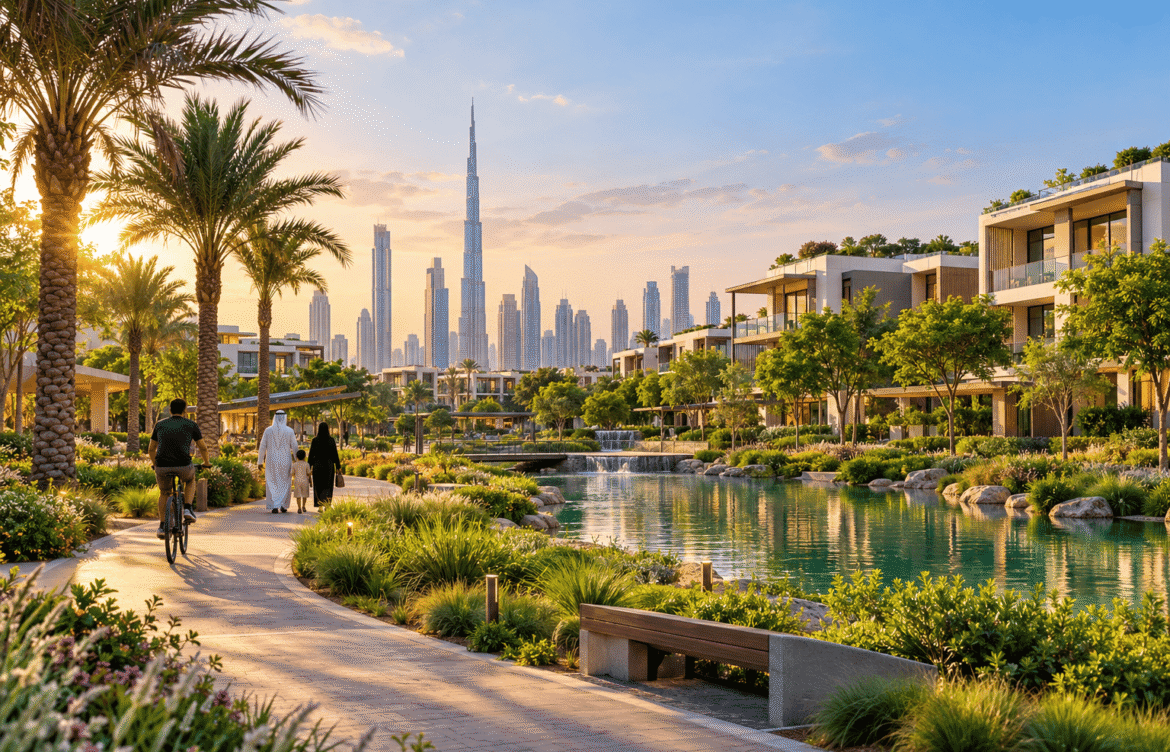
Imagine a residential community where a resident can leave home and walk through a shaded landscaped pathway, reach a nearby park, use an outdoor fitness area and continue to a community retail space without needing to drive for every activity.
The landscape becomes part of the daily infrastructure of the community.
This is why nature-led development is closely connected with concepts such as:
- Walkability
- Outdoor recreation
- Community interaction
- Wellness
- Family-friendly planning
- Active mobility
- Quality public spaces
Dubai Municipality’s current greenery framework explicitly connects green and open spaces with health and wellbeing, connectivity, walking and cycling, biodiversity and climate resilience.
Nature-Led Communities and Property Buyers
For property buyers, it is important to look beyond marketing phrases such as green community, eco-friendly development or nature-inspired living.
A buyer should look at what the development actually provides.
Questions buyers can ask include:
1. How much usable outdoor space is available?
A large landscaped area is not necessarily the same as a park that residents can actually use.
2. Are green spaces connected?
Connected walking routes can be more useful than several isolated landscaped areas.
3. Are pathways shaded?
In the UAE climate, shade can significantly affect how comfortable outdoor areas are.
4. What type of landscaping is being used?
Ask whether the planting strategy considers water efficiency and local conditions.
5. How will the community be maintained?
A beautiful landscape at launch needs an appropriate long-term maintenance strategy.
6. What facilities are within walking distance?
A nature-led community can be more functional when parks, recreation, retail and community facilities are connected.
7. What are the service charges?
More extensive landscaping and community facilities can also involve ongoing maintenance costs, so buyers should understand the overall cost structure.
Importantly, green space by itself should not be treated as a guarantee of higher property value. Location, connectivity, construction quality, developer track record, supply and demand, community facilities and broader market conditions all remain relevant.
Nature-Led Development Across the UAE
The concept is not limited to Dubai.
Different emirates are also developing sustainability and community-planning frameworks.
Dubai
Dubai’s 2040 planning framework places emphasis on parks, open spaces, environmental quality, ecological corridors, sustainable mobility and water management.
Dubai Municipality’s 2026 Greenery and Plantation Manual further develops guidance for parks, green corridors and landscaped public spaces.
Ras Al Khaimah
Ras Al Khaimah has introduced Sustainable Community Guidelines covering the emirate. The guidelines focus on pedestrian-friendly streets and public spaces while seeking to reduce energy and water consumption and environmental impact.
Its Sustainable Communities programme also addresses energy-efficient buildings and communities, community design guidelines and sustainable development standards.
Abu Dhabi and the Wider UAE
Sustainability is also part of the UAE’s broader policy framework. The UAE government’s environmental and energy framework includes the UAE Green Agenda 2030, National Climate Adaptation Action Plan, UAE Net Zero 2050 Strategy, National Climate Change Plan and other sustainability programmes.
This broader policy environment provides context for why sustainable urban development is becoming an increasingly important consideration across the UAE.
What Does This Mean for the Future of UAE Real Estate?
The evolution toward nature-led communities suggests that future residential development may increasingly focus on the complete living environment rather than the individual property alone.
A successful community may need to bring together:
Homes + landscape + mobility + amenities + sustainability + public spaces
This approach also creates opportunities for developers to think differently about residential design.
Instead of asking:
How can we add more amenities to a project?
The question can become:
How can the entire community be designed around the way residents actually live?
This shift is already reflected in Dubai’s planning direction, where parks, open spaces, active mobility, environmental resilience and community facilities are considered within a broader urban structure.
How Developers Can Respond to the Nature-Led Trend
For developers, the transition toward nature-led communities requires consideration from the early planning stage.
Key areas include:
Master Planning
Landscape and public spaces should be considered alongside residential and infrastructure planning.
Landscape Architecture
Planting, shade, pathways and outdoor areas should respond to the UAE’s climate.
Water Management
Irrigation should be designed for efficient long-term operation.
Community Connectivity
Walking and cycling routes should connect important destinations wherever practical.
Long-Term Maintenance
The design should consider operational requirements after project completion.
Resident Experience
Outdoor areas should have a practical purpose rather than being included purely for visual appeal.
For companies involved in project planning, development and execution, this also makes coordination between design, construction and project management particularly important.
The Role of Project Management in Nature-Led Developments
Creating a nature-led community involves multiple disciplines.
Architects, landscape designers, engineers, contractors, consultants and project managers may all need to coordinate their work.
This is where structured project management becomes important.
A project management team can help coordinate:
- Planning
- Design development
- Construction
- Contractor coordination
- Quality control
- Project timelines
- Site execution
- Handover
For example, ZZZ Project Management’s project management services cover project planning, project management, contract management and project development.
Nature-Led Thinking in Luxury Residential Development
The nature-led concept is also relevant to luxury residential property.
Today’s luxury is increasingly about the overall experience of a property rather than only expensive finishes.
Private gardens, landscaped outdoor areas, swimming pools, walking routes, waterfront surroundings and outdoor entertainment spaces can all contribute to the way residents experience a home.
For example, USquare Luxe Properties develops luxury villas and residential communities across Dubai and the UAE, with its current portfolio including Ramada Residences by Wyndham Dubai Islands and luxury villas in Al Furjan.
What Homebuyers Should Look For in a Nature-Led Community
Before purchasing a property, buyers can use this simple checklist:
Location
Is the community connected to major roads, public transport and essential services?
Green Space
Are there meaningful parks, gardens or landscaped areas?
Walkability
Can residents comfortably move around the community without relying on a car for every short journey?
Shade
Are walking routes and outdoor gathering spaces designed for the UAE climate?
Landscaping
Does the landscape strategy consider water efficiency and long-term maintenance?
Amenities
Are outdoor recreation, fitness, children’s facilities and community spaces available?
Maintenance
Who will maintain the landscape and shared facilities after completion?
Overall Cost
Do service charges and ongoing community costs match the facilities being provided?
Developer Track Record
What is the developer’s history of delivering and maintaining residential projects?
This approach allows buyers to evaluate a development based on actual planning and operational features, rather than simply relying on marketing terminology.
Conclusion
The rise of nature-led communities represents a broader change in the way residential development is being considered across the UAE.
Nature is no longer simply a decorative element placed around buildings. Green corridors, parks, shaded pathways, outdoor recreation, sustainable irrigation, walkability and environmental planning can all form part of a much larger community strategy.
Dubai’s 2040 Urban Master Plan and its newer greenery guidance demonstrate how parks, open spaces, ecological corridors, active mobility and environmental resilience are becoming part of the city’s long-term planning framework.
For developers, this means thinking beyond individual buildings and considering the complete environment in which people will live.
For buyers, it means looking beyond the apartment or villa itself and understanding how the wider community is designed, connected and maintained.
The future of UAE real estate may therefore be shaped not only by bigger homes, better architecture or more amenities, but by communities that bring together people, property and the natural environment in a more integrated way.