

- By USquare Luxe Properties
- September 17, 2026
How Roads, Metro and Infrastructure Development Affect Property Values in Dubai
Dubai’s property market is shaped by more than just buildings, prices, and views. One of the most important factors behind property demand is infrastructure. Roads, metro stations, public transport, bridges, and other infrastructure projects can make an area easier to reach, more convenient to live in, and more attractive to buyers and tenants.
As Dubai continues to expand, new communities are being developed alongside better transport connections and supporting infrastructure. This development can influence how people choose where to live and where investors look for Dubai property investment opportunities.
But how exactly does infrastructure development affect property values in Dubai? And does living close to a metro station or a major road always mean a property will be worth more?
Let’s explore the connection between roads, metro, infrastructure development, and Dubai property values.
Why Infrastructure Matters for Dubai Property Values
Infrastructure plays an important role in how attractive a location is for residents, tenants, businesses, and property investors. A well-connected area can offer easier access to workplaces, schools, shopping destinations, airports, entertainment venues, and other parts of the city.
When an area becomes easier to access, demand for property may increase. Higher demand can support property prices and rental demand, although infrastructure is only one of several factors that influence real estate values.
The Link Between Connectivity and Property Demand
People generally prefer homes that make their daily travel easier.
For example, a resident who works in Downtown Dubai may prefer a community with convenient road or metro connections. Similarly, a tenant may be willing to consider a property further from the city centre if it has good access to major roads or public transport.
This is why connectivity can influence property demand.
Good infrastructure can reduce travel difficulties and make a neighbourhood more practical for everyday life. As more people consider an area convenient, the demand for homes in that location may also increase.
Why Location Alone Is No Longer Enough
Location has always been one of the most important factors in real estate. However, the meaning of a good location has changed as Dubai has grown.
A property does not necessarily need to be in the traditional city centre to attract buyers or tenants. A well-planned community with good roads, public transport, nearby amenities, and easy access to important areas can also become attractive.
This is particularly important in Dubai, where new residential communities continue to develop across different parts of the emirate.
How Roads and Highways Affect Property Prices in Dubai
Dubai has an extensive road network connecting residential communities, commercial districts, airports, and major attractions. Roads and highways can have a direct impact on how easily people can move between different parts of the city.
For property buyers, accessibility can be an important part of the location decision.
Better Road Connectivity and Accessibility
A property with convenient access to major roads can make daily travel easier.
Residents may be able to reach their workplace, schools, shopping centres, or other destinations more efficiently. This can make the surrounding community more attractive to people who rely on private vehicles.
For example, communities with easy access to major routes such as Sheikh Zayed Road, Sheikh Mohammed Bin Zayed Road, Emirates Road, or Al Khail Road can benefit from their connections to different parts of Dubai.
However, being close to a major road is not automatically positive. Buyers also consider factors such as traffic, noise, access points, and the actual distance between the property and the road.
How New Roads Can Increase Demand in Emerging Areas
Infrastructure development can also support the growth of developing communities.
When a new road, interchange, bridge, or improved connection makes an area easier to reach, the community may become more accessible to residents and businesses.
This can create new interest in areas that were previously considered less convenient.
For investors, this is one reason infrastructure plans are worth following. A developing area may look very different after major connectivity improvements are completed.
The Role of Travel Time in Property Selection
For many buyers and tenants, the question is simple:
“How long will it take me to get where I need to go?”
Travel time can influence property decisions, especially for people commuting regularly to work.
Two properties with similar prices and features may attract different levels of interest if one offers significantly easier access to major employment and lifestyle areas.
This makes accessibility an important factor when comparing properties across Dubai.
How Dubai Metro Affects Property Values
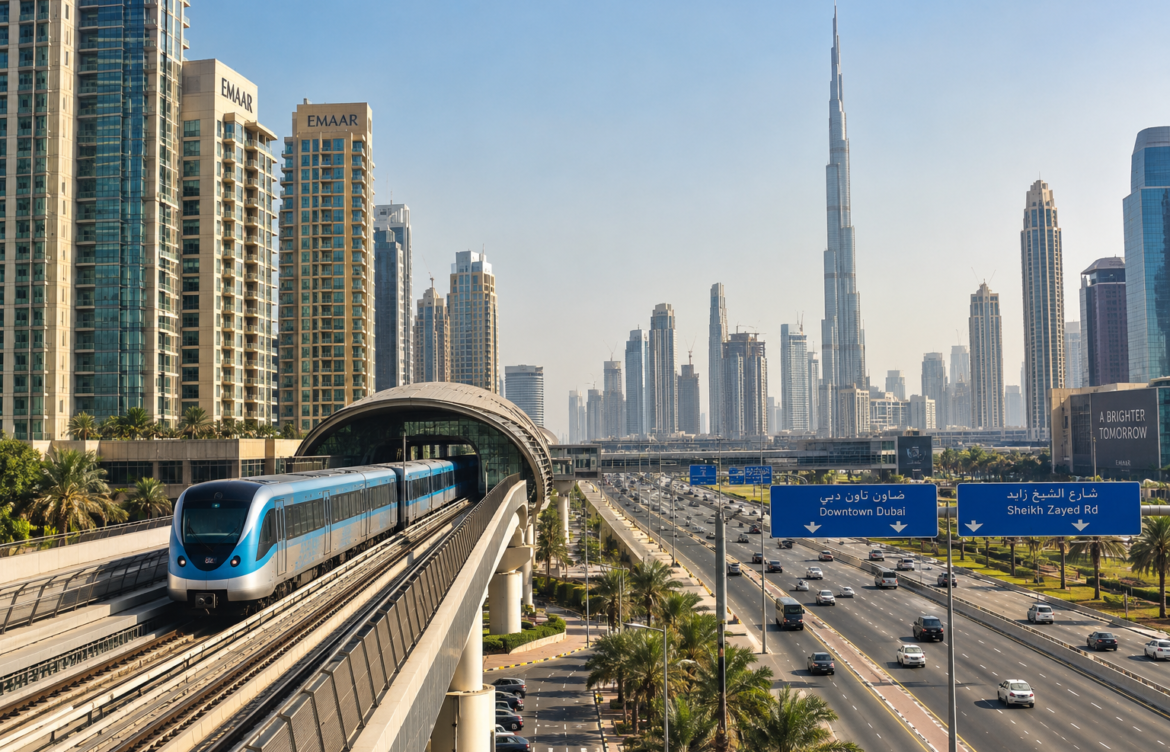
The Dubai Metro is one of the city’s most important public transport systems and has changed the way many residents travel around the emirate.
For people who prefer public transport, living near a metro station can provide a practical alternative to driving.
Why Properties Near Metro Stations Attract Buyers
Properties near metro stations can appeal to buyers and tenants who value convenient public transport.
Metro access can be particularly useful for residents who commute to business districts, shopping areas, tourist destinations, or other locations connected to the network.
According to CBRE’s Dubai Metro Report, residential properties within a 15-minute walk of Dubai Metro Red Line stations recorded average price growth of 26.7% between Q1 2010 and Q4 2022, compared with 24.1% for Dubai’s overall residential market. This provides an example of how transport accessibility can be connected with property performance, although it does not mean that every property near a metro station will automatically increase in value.
The Impact of Metro Access on Rental Demand
Metro connectivity can also be important for the rental market.
Tenants often consider their daily commute when choosing a home. For someone who does not drive, or prefers not to use a car every day, being within walking distance of a metro station can be a major advantage.
This can make metro-connected properties relevant to a wider tenant audience.
However, rental demand also depends on factors such as property quality, rent level, community facilities, unit size, nearby employment areas, and competition from other properties.
How Metro Connectivity Can Support Long-Term Property Value
Infrastructure can influence property value over time by improving accessibility and convenience.
When transport connections become established, surrounding communities may become more integrated with the wider city. This can support residential and commercial activity.
For investors, the important point is not simply to look for a property “near the metro.” It is better to consider the overall location, walking distance, quality of the property, surrounding amenities, and future development.
You can also explore Dubai’s current property developments and projects to understand how different communities and developments are positioned within Dubai’s wider real estate market.
How Public Transport Infrastructure Influences Dubai Real Estate
Dubai’s transport network includes more than just the Metro. The wider public transport system also includes trams, buses, taxis, and other mobility options.
Together, these services contribute to the overall accessibility of different communities.
For information about Dubai’s public transport network, residents and property buyers can refer to the Roads and Transport Authority (RTA).
Metro, Tram and Bus Connectivity
A strong public transport network gives residents more options for moving around the city.
Areas connected to multiple forms of transport can be attractive to people who want flexibility in their daily travel.
For example, a community with access to a metro station and convenient bus connections may offer greater mobility than an area where residents have very limited transport choices.
Accessibility for Residents and Tenants
Accessibility matters to different people for different reasons.
A family may value easy access to schools and shopping centres. A professional may focus on commuting to work. A tenant without a car may prioritise public transport.
Because Dubai has a diverse population, properties that offer convenient access to important destinations can appeal to a broad range of residents.
The Connection Between Transport and Rental Demand
Good transport connections can increase the practical appeal of a location.
When tenants compare properties, they often look at more than the size and design of the apartment. They may also consider how easily they can reach work, public transport, supermarkets, schools, restaurants, and other daily needs.
This is why transport accessibility can become one part of a property’s overall rental appeal.
How New Infrastructure Creates Emerging Property Hotspots
Infrastructure development can sometimes change the perception of a location.
An area that once had limited connectivity may become more attractive after improvements to roads, public transport, community facilities, or other infrastructure.
From Developing Communities to Established Neighbourhoods
Many Dubai communities have developed gradually.
New roads and transport connections can support this process by making communities easier to access. As more residents move in, businesses and services may also expand to meet local demand.
Over time, this can contribute to the transformation of a developing neighbourhood into a more established community.
For example, Al Furjan demonstrates how residential communities can combine housing, retail, amenities, roads and public transport connections to create a more convenient living environment.
Why Early Investors Watch Infrastructure Plans
Property investors often look beyond what an area offers today.
They may also consider what is planned for the future.
Upcoming roads, metro extensions, transport improvements, schools, retail destinations, and other developments can provide useful information when evaluating a location.
However, investors should distinguish between announced plans, projects under construction, and completed infrastructure. A planned project can face changes in timing, design, or scope.
Infrastructure as a Sign of Future Area Growth
Infrastructure investment can indicate that an area is becoming an important part of Dubai’s wider development.
But infrastructure alone does not guarantee property price growth.
Investors should consider infrastructure alongside population growth, supply levels, amenities, employment access, rental demand, and the wider property market.
Dubai Infrastructure Projects That Can Influence Real Estate Demand
Dubai continues to invest in transport and infrastructure as the city grows.
Major road improvements, public transport projects, new connections, and community infrastructure can change accessibility across different areas.
Projects such as Dubai Metro expansion plans, road improvements, new interchanges, and public transport upgrades are therefore relevant to property buyers and investors when assessing future accessibility.
The Dubai Metro Blue Line is one example of a major transport project that is relevant when considering Dubai’s future connectivity and urban development.
The important thing is to look at each project individually.
Investors should ask:
- Where exactly is the project located?
- Which communities will benefit from it?
- When is it expected to be completed?
- Will it reduce travel time?
- Will it improve access to public transport?
- Is the surrounding area already experiencing population or development growth?
- How much new property supply is being added nearby?
These questions provide a more realistic picture than simply assuming that every infrastructure project will increase property prices.
How Infrastructure Development Affects Rental Yields
Infrastructure can also influence the rental side of Dubai’s property market.
A well-connected property may appeal to tenants because convenience is an important part of choosing a home.
Why Better Connectivity Can Attract Tenants
Tenants usually want a home that fits their lifestyle and budget.
For some, that means being close to a metro station. For others, easy highway access may be more important.
If a property offers convenient access to workplaces, transport, schools, shopping, and other facilities, it may have a wider potential tenant audience.
Infrastructure and Rental Demand
Improved infrastructure can make an area more accessible and practical.
As an area becomes better connected, it may attract more residents. This can support rental demand, but the effect depends on the balance between demand and available housing supply.
If many new properties enter the market at the same time, landlords may also face increased competition.
What Investors Should Look at Beyond Property Prices
Rental yield should not be judged only by the purchase price.
Investors should also consider:
- Expected rental income
- Service charges
- Maintenance costs
- Vacancy periods
- Property management costs
- Community demand
- Nearby competing properties
- Future supply
- Accessibility and transport connections
A property with excellent infrastructure access may still require careful financial analysis before purchase.
For buyers exploring different Dubai property projects, comparing connectivity alongside the property’s price, amenities, rental potential and future supply can provide a more complete picture.
How to Evaluate Infrastructure Before Buying Property in Dubai
Infrastructure should be part of a wider property research process.
Before buying, investors can look at both the current situation and the future development of the area.
Check Current Transport Connections
Start by checking how easily the property connects to major roads and public transport.
Consider actual travel times rather than simply looking at a map.
A property advertised as “near the metro” may still require a significant walk or another form of transport.
The RTA public transport network is a useful official source for checking Dubai’s transport infrastructure and connectivity.
Look at Planned Infrastructure Projects
Research officially announced infrastructure projects and check their expected timelines.
Do not rely only on property advertisements or social media claims.
Official government and transport authorities are generally more reliable sources for project information.
Consider Accessibility to Business and Lifestyle Destinations
Think about where residents actually need to go.
For example:
- Business districts
- Schools
- Hospitals
- Shopping centres
- Airports
- Beaches
- Entertainment destinations
- Major employment hubs
A well-connected property can be more useful when it provides practical access to several important destinations.
Compare Current Prices With Future Development Potential
Infrastructure can be one factor when comparing property prices across different communities.
Instead of asking only whether an area is expensive or affordable, investors can ask:
“What am I getting for the price today, and how could the area change over time?”
This approach helps create a broader picture of the property’s potential.
Does Better Infrastructure Always Increase Property Values?
Not necessarily.
Infrastructure is an important factor, but property values are influenced by many other elements.
These can include location, property quality, developer reputation, supply and demand, community amenities, rental demand, economic conditions, interest rates, and the overall performance of Dubai’s real estate market.
For example, a property may be close to a major road but have limited demand because of noise or difficult access. Similarly, a property may be far from a metro station but remain attractive because it offers strong community facilities, larger homes, and convenient road access.
The relationship between infrastructure and property values is therefore not automatic.
The strongest approach is to look at infrastructure as part of the bigger real estate picture.
Final Thoughts
Infrastructure is one of the factors that can shape the future of Dubai’s property market.
Better roads can improve accessibility. Metro and public transport can make daily commuting easier. New infrastructure can also support the development of emerging communities and connect them more closely with established areas of Dubai.
For property buyers and investors, the key is to look beyond today’s property price. Understanding how a location is connected today and how it may be connected in the future can provide valuable insight when comparing different investment opportunities.
At the same time, infrastructure should never be viewed in isolation. Property quality, supply and demand, rental potential, amenities, developer reputation, and overall market conditions remain important parts of the decision.
In a fast-growing city like Dubai, infrastructure and real estate are closely connected—and understanding that relationship can help buyers and investors make more informed property decisions.
Frequently Asked Questions
Metro accessibility can contribute to the attractiveness and demand of properties in nearby areas. Research by CBRE found a relationship between proximity to Dubai Metro stations and residential price performance, but metro access is only one factor affecting property values.
Good road connectivity can make a property easier to access and may increase its appeal to buyers and tenants. However, factors such as traffic, noise, accessibility, and the quality of the surrounding community also need to be considered.
Investors can consider road connectivity, metro and public transport access, travel times, planned infrastructure projects, nearby amenities, and the future development of the surrounding community.
It can. Convenient access to public transport may attract tenants who value easy commuting, particularly those who do not own a car. However, rental demand also depends on rent levels, property quality, location, amenities, and competing supply.
Yes, improved infrastructure can make an emerging area more accessible and potentially more attractive. However, investors should evaluate the complete market, including future property supply, demand, amenities, development timelines, and current prices rather than relying on infrastructure alone.